
Winchester is a lovely, mostly peaceful place to bring up children. That’s exactly why it’s easy to put off the safety conversations until something happens. In our classes we talk about personal safety with children regularly, and the most useful part often isn’t the physical technique. It’s having a plan they’ve thought about in advance.
Here are five conversations we have in class, and that are worth having at home too. Ask your child what they’d do before you tell them. Their answers can be surprising.
1. “What would you do if you lost me?”
Most children say they’d run around looking. It’s the natural reaction and usually the wrong one. We teach them to stay where they are, so the grown-up looking for them only has to retrace their steps.
If they need help, the safest people to ask are a parent with children, or someone working there: a person at a shop till, a steward in a high-vis jacket or a police officer. It’s worth agreeing a meeting point when you arrive somewhere busy, like the Christmas market or a summer event in town, and making sure older children know your phone number by heart.
2. “What if someone needs help on the ice or in the water?”
Children want to be heroes, especially if a friend or a dog is in trouble. The message here is simple and needs repeating. Never go onto ice or into water after someone. Shout for an adult, and call 999 if you have a phone. Being sensible is the brave choice.
3. “Tricky people”, not “stranger danger”
Most strangers are kind, and some are the very people who’ll help a lost child. So rather than “stranger danger”, we talk about tricky people: anyone, known or unknown, who behaves in a way that should set off alarm bells.
A tricky person might:
- ask a child to keep a secret from their parents
- ask a child for help, when a grown-up should ask another grown-up
- try to get them to go somewhere without checking with a parent first
- give them that uneasy feeling in their tummy.
We tell children to trust that feeling. If something feels wrong, they should move away and tell a trusted adult. There’s more in our guide to stranger danger for kids.
4. “Your body belongs to you”
Children need to know they can say no to any touch that makes them uncomfortable, even from someone they know. They also need to know that surprises are fine but secrets from parents are not. A child who knows they won’t be in trouble for telling is much safer than one who isn’t sure.
5. “What if someone grabs you, or a bully won’t leave you alone?”
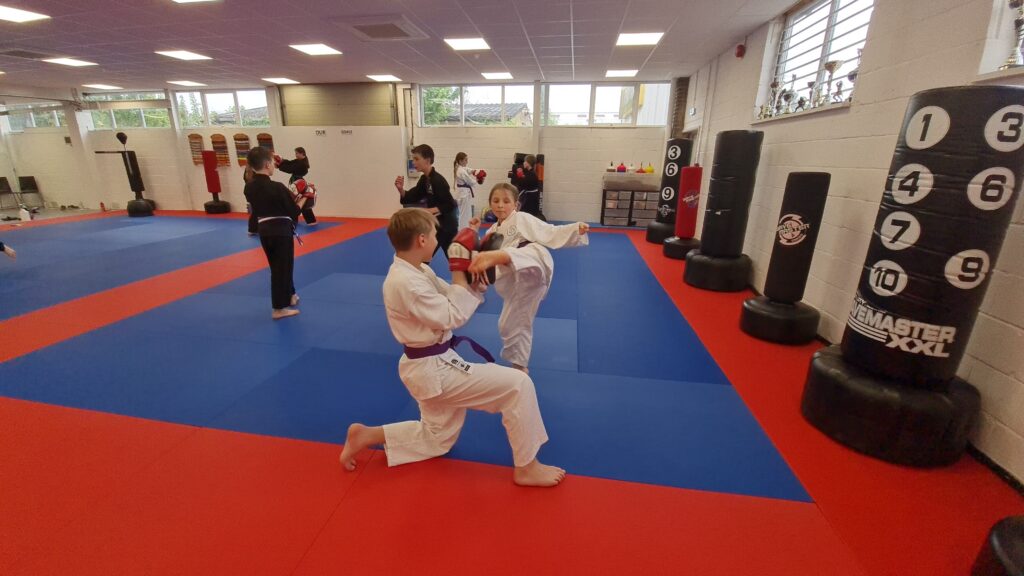
This is the conversation children find the most frightening, so we keep it calm and practical. The aim is a plan, not a fight: make a loud noise, get away, and tell someone. In class, children practise breaking free from grabs and using a strong voice. Practising it in a safe room makes it far more likely they’ll do it under pressure.
For bullying, children learn confident body language, how to use their voice to set a boundary, and that telling an adult is not “snitching”.
One boy told us he was being bullied at school. It wasn’t physical. It was name-calling and mean comments, which can hurt just as much. So we practised in class, with him and some of the other children, what to do when someone calls you names. We came up with replies that weren’t rude or threatening, but showed the other person it wasn’t working. If someone says “Hey, four eyes”, you might answer, “Oh, you noticed my new glasses.” We talked it through with his parents too, so they could practise with him at home.
Two weeks later he came in with a huge grin. The same boy had tried the same insult at school, and he’d simply laughed. The other boy got upset and walked off. His teacher later told his parents it had worked, and that the other child had been having a hard time himself. The name-calling had lost its power.
How our classes help
Our classes for children combine Karate and Chinese Kung Fu, including throws and groundwork. That means children learn to keep distance, break free when someone is close, and get back to their feet if they end up on the floor. Just as important, they learn awareness and how to avoid trouble in the first place.
Parents can watch every class from the seating area right beside the mats, and we follow a clear code of practice for parents and carers.
If you’d like your child to try a class, book a free taster class or see our kids Martial Arts classes. You can also read about our coaches and their qualifications.